By Dr. Shumaila Yousafzai, Alua Nurbayeva, PhD student at NUGSB
Co-authors Dr. Rana Zayadin, Dr Muzhar Javed
What if leadership is not the loudest voice in the room, not the fastest growth curve, not the person who “wins” by outpacing everyone else, but the person (or the community) who keeps life possible?
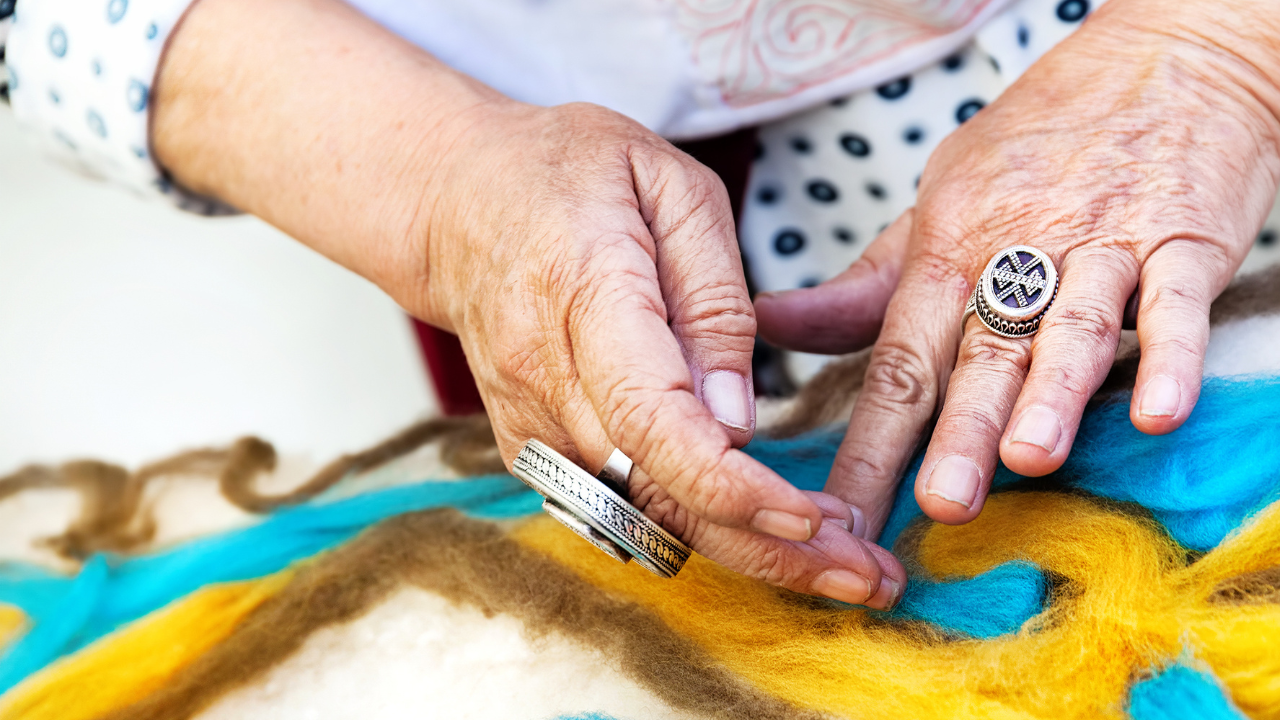
We listened closely to 21 women who were leading craft-based ventures, women whose work is often dismissed as “small,” “traditional,” or “informal,” and therefore placed outside the canonical leadership spotlight. Through in-depth interviews, their stories did something powerful: they shifted the center of gravity. They showed that leadership can be a form of decolonial work, i.e., an everyday reordering of power, meaning, and belonging.
What emerged was not a list of traits, but a three-layer process model of Decolonial Feminist Leadership, a leadership that is as much about how one holds the world as it is about how one runs a venture.
The first layer is temporal sovereignty — the reclaiming of time. These women were not simply “managing schedules.” They were resisting the demand to live in permanent urgency. They were refusing the tyranny of endless deadlines and market-speed as the only legitimate rhythm of work. Instead, they described leadership as the right to set time differently: to work in seasonal rhythms, to honour family and community obligations without shame, to create without being rushed into imitation or compromise. Time, in their hands, was not a neutral resource. It was political territory. Reclaiming time was the first act of leadership.
The second layer is relational infrastructures of care — the reclaiming of the social fabric that makes work possible. Leadership here is not “individual brilliance” or heroic self-reliance. It is building a web: mentoring young women, teaching craft knowledge, sharing resources, opening doors for others, creating safe spaces for learning, healing, and earning. Care is not presented as an emotional add-on or a private burden. In this model, care becomes infrastructure—practical, material, organized, and strategic. It is what holds enterprises steady when institutions are absent, when systems are indifferent, when the market rewards extraction over dignity.
The third layer is distributed cultural stewardship — the reclaiming of meaning and cultural space. These ventures are not merely producing goods. They are protecting and re-animating cultural memory. Leadership becomes a shared act of guardianship: sustaining heritage, reviving suppressed aesthetics and practices, and ensuring that the enterprise does not become a factory of “marketable culture,” stripped of soul. Stewardship is distributed because culture cannot be held by one person alone; it is carried through networks, elders, apprentices, customers, communities. In this layer, leadership is an ecosystem — more like a living landscape than a hierarchy.
Together, these layers show something the mainstream leadership story often misses: in marginalised and postcolonial settings, leadership is not only about performance. It is about repair. It is not only about strategy. It is about survival with dignity. It is not only about “success.” It is about sovereignty—over time, over space, over identity, over the right to define what flourishing looks like.
That is the paper’s contribution: it offers a grounded, empirically-derived model of Decolonial Feminist Leadership that expands leadership studies beyond speed, scale, and individualism, toward temporal sovereignty, care as infrastructure, and cultural stewardship as a leadership practice. It also invites entrepreneurship and creative industries research to take seriously what is often treated as peripheral: craft, heritage, relational work, and women’s leadership enacted through community-making rather than self-branding.
And yet, after all the interviews, after shaping the model, the real question remains — one that reaches far beyond Kazakhstan:
If these women can reclaim time, build relational infrastructures of care, and practise distributed cultural stewardship in the face of historical erasure and contemporary market pressure… what kinds of leadership might we all be missing when we keep celebrating only the loudest, fastest, most individualistic stories?
Co-authors Dr. Rana Zayadin, Dr Muzhar Javed
What if leadership is not the loudest voice in the room, not the fastest growth curve, not the person who “wins” by outpacing everyone else, but the person (or the community) who keeps life possible?
In the dominant story, leadership is measured in acceleration: more outputs, more visibility, more scale, more speed. But what happens when the world you lead within carries the weight of erased languages, interrupted lineages, and a post-Soviet landscape where time itself has been reorganized, by institutions, by market logics, by inherited forms of control? What does leadership look like when it is not performed from a polished stage, but practiced in workshops, kitchens, shared studios, and community spaces, where survival, dignity, and cultural continuity sit beside profit?
We listened closely to 21 women who were leading craft-based ventures, women whose work is often dismissed as “small,” “traditional,” or “informal,” and therefore placed outside the canonical leadership spotlight. Through in-depth interviews, their stories did something powerful: they shifted the center of gravity. They showed that leadership can be a form of decolonial work, i.e., an everyday reordering of power, meaning, and belonging.
What emerged was not a list of traits, but a three-layer process model of Decolonial Feminist Leadership, a leadership that is as much about how one holds the world as it is about how one runs a venture.
The first layer is temporal sovereignty — the reclaiming of time. These women were not simply “managing schedules.” They were resisting the demand to live in permanent urgency. They were refusing the tyranny of endless deadlines and market-speed as the only legitimate rhythm of work. Instead, they described leadership as the right to set time differently: to work in seasonal rhythms, to honour family and community obligations without shame, to create without being rushed into imitation or compromise. Time, in their hands, was not a neutral resource. It was political territory. Reclaiming time was the first act of leadership.
The second layer is relational infrastructures of care — the reclaiming of the social fabric that makes work possible. Leadership here is not “individual brilliance” or heroic self-reliance. It is building a web: mentoring young women, teaching craft knowledge, sharing resources, opening doors for others, creating safe spaces for learning, healing, and earning. Care is not presented as an emotional add-on or a private burden. In this model, care becomes infrastructure—practical, material, organized, and strategic. It is what holds enterprises steady when institutions are absent, when systems are indifferent, when the market rewards extraction over dignity.
The third layer is distributed cultural stewardship — the reclaiming of meaning and cultural space. These ventures are not merely producing goods. They are protecting and re-animating cultural memory. Leadership becomes a shared act of guardianship: sustaining heritage, reviving suppressed aesthetics and practices, and ensuring that the enterprise does not become a factory of “marketable culture,” stripped of soul. Stewardship is distributed because culture cannot be held by one person alone; it is carried through networks, elders, apprentices, customers, communities. In this layer, leadership is an ecosystem — more like a living landscape than a hierarchy.
Together, these layers show something the mainstream leadership story often misses: in marginalised and postcolonial settings, leadership is not only about performance. It is about repair. It is not only about strategy. It is about survival with dignity. It is not only about “success.” It is about sovereignty—over time, over space, over identity, over the right to define what flourishing looks like.
That is the paper’s contribution: it offers a grounded, empirically-derived model of Decolonial Feminist Leadership that expands leadership studies beyond speed, scale, and individualism, toward temporal sovereignty, care as infrastructure, and cultural stewardship as a leadership practice. It also invites entrepreneurship and creative industries research to take seriously what is often treated as peripheral: craft, heritage, relational work, and women’s leadership enacted through community-making rather than self-branding.
And yet, after all the interviews, after shaping the model, the real question remains — one that reaches far beyond Kazakhstan:
If these women can reclaim time, build relational infrastructures of care, and practise distributed cultural stewardship in the face of historical erasure and contemporary market pressure… what kinds of leadership might we all be missing when we keep celebrating only the loudest, fastest, most individualistic stories?