

Concentrated markets and firms that hold the top positions in their industry year after year are widely taken as signs of market power. But does having a few firms account for most sales, or seeing the same firms stay at the top, necessarily indicate market power? Using confidential data on Kazakhstan's medium and large firms for 2016–2023, NUGSB's David DeRemer and Aigerim Yergabulova find that in Kazakhstan, on their own, these two signs say little about market power. More concentrated industries do not earn higher markups. The state’s role helps explain this pattern: industries with a larger state presence tend to be more concentrated, yet state enterprises report lower markups than private firms in the same industry. The second sign is also not clear-cut: firms that keep their top positions report innovation activity more often than those overtaken by rivals.
Do standard screens for market power work well in Kazakhstan?
A market is concentrated when a few firms account for a large share of its sales. The concern is that these firms can more easily exercise market power—the ability to charge prices above competitive levels. Competition authorities use concentration statistics such as the Herfindahl–Hirschman index (HHI), which measures how sales are distributed among firms, to screen markets for market power. These measures feature prominently in the thresholds used to assess mergers. Kazakhstan's Agency for Protection and Development of Competition (APDC), for example, routinely uses HHI and concentration-ratio thresholds to classify markets by how concentrated they are.
Concentration and the persistence of leading firms are market outcomes, however, and both can arise for reasons unrelated to market power. Leaders may simply be more efficient than their rivals. In Kazakhstan, a large oil sector and the state's organization and regulation of markets can further weaken the link. Whether concentration and persistent market leadership reflect market power matters especially in Kazakhstan and similar economies trying to diversify away from natural resources. Competition policy that targets actual market power affects who benefits from the new technologies that diversification requires.
The authors ask whether more concentrated industries in Kazakhstan earn higher markups—the ratio of prices to costs—and whether leading firms that maintain their positions are innovative. For this descriptive analysis, the study uses a confidential census of medium and large enterprises collected by the Bureau of National Statistics (reporting form 1-PF). The data cover 67 nationally defined industries in the non-financial business economy over 2016–2023, with about 3,100 to 3,300 firms per year.
A market is concentrated when a few firms account for a large share of its sales. The concern is that these firms can more easily exercise market power—the ability to charge prices above competitive levels. Competition authorities use concentration statistics such as the Herfindahl–Hirschman index (HHI), which measures how sales are distributed among firms, to screen markets for market power. These measures feature prominently in the thresholds used to assess mergers. Kazakhstan's Agency for Protection and Development of Competition (APDC), for example, routinely uses HHI and concentration-ratio thresholds to classify markets by how concentrated they are.
Concentration and the persistence of leading firms are market outcomes, however, and both can arise for reasons unrelated to market power. Leaders may simply be more efficient than their rivals. In Kazakhstan, a large oil sector and the state's organization and regulation of markets can further weaken the link. Whether concentration and persistent market leadership reflect market power matters especially in Kazakhstan and similar economies trying to diversify away from natural resources. Competition policy that targets actual market power affects who benefits from the new technologies that diversification requires.
The authors ask whether more concentrated industries in Kazakhstan earn higher markups—the ratio of prices to costs—and whether leading firms that maintain their positions are innovative. For this descriptive analysis, the study uses a confidential census of medium and large enterprises collected by the Bureau of National Statistics (reporting form 1-PF). The data cover 67 nationally defined industries in the non-financial business economy over 2016–2023, with about 3,100 to 3,300 firms per year.
More concentrated industries do not earn higher markups
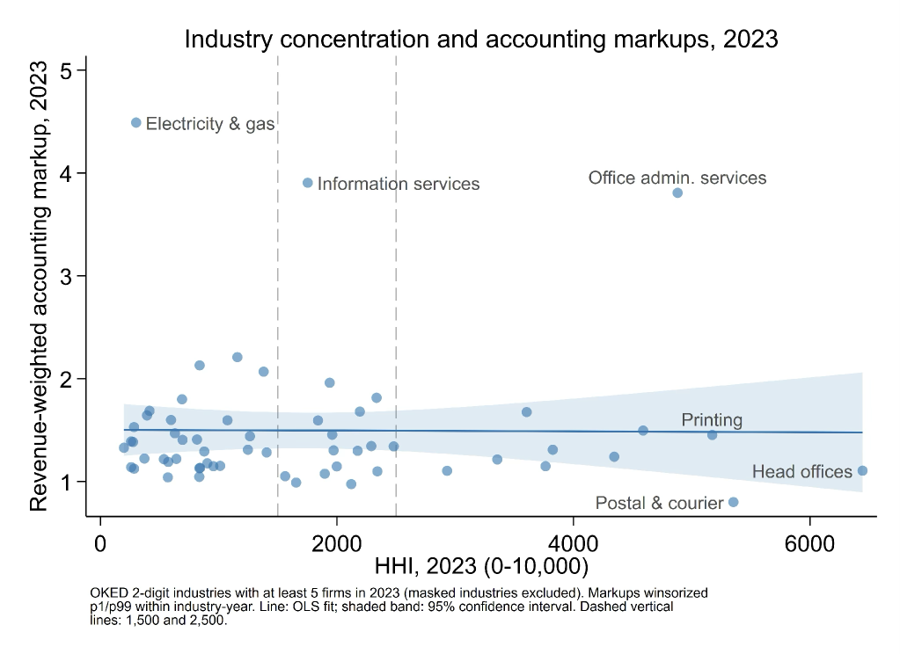
Source: DeRemer and Yergabulova (2026), Figure 3, using Bureau of National Statistics data (form 1-PF)
If concentration reflects market power, more concentrated industries should earn higher markups. This prediction underpins the use of concentration to screen for market power, whether leading firms became large through greater efficiency or protection from competition. But across Kazakhstan’s industries in 2023, the correlation between HHI and accounting markups is −0.01—essentially zero—as the figure’s nearly flat line shows. Likewise, within industries over time, no estimate shows markups rising with concentration.
The absence of a relationship between markups and concentration holds even when more sophisticated methods are used to estimate markups. Accounting markups omit the cost of capital, so capital-intensive industries can look profitable when they are only covering fixed costs. Yet the result is unchanged when accounting for differences in capital intensity. Markup measures that better capture the true cost of producing one additional good or service ,also show no positive relationship with concentration.
The state's role in markets helps explain the absence of the concentration-markup relationship. Electricity and gas have the highest markups of any industry but are among the least concentrated. Regulators set their tariffs, and the sector requires substantial capital investment. Postal services are the opposite case. A national operator with service obligations across the country dominates the industry. The industry’s revenues do not cover its variable costs. More generally, industries where state enterprises account for a larger share of revenue tend to be more concentrated, yet state enterprises report lower markups than private firms in the same industry. This pattern appears even though the ownership data classify state-held joint-stock companies as private, understating the state’s presence.
Commodity prices are a second reason concentration does not track markups. Where prices are set in world markets, measured markups and revenues reflect those prices rather than market structure. Oil shows this most plainly. The oil sector's own HHI rose with prices, peaking above 5,000 in 2022. Because the economy-wide index weights industries by revenue, it tracks the oil cycle: of its 257-point rise in 2022, only 16 points remain once oil and gas is excluded. While the effect of commodity prices on oil concentration measures may be obvious, similar effects of prices, tariffs or administrative decisions in other sectors may be harder to recognise.
Leaders that stay on top are more often innovators
When the same firms stay on top for years, authorities may suspect that they are shielded from competition and have little reason to innovate. In Kazakhstan, leading positions are quite stable. Of the four largest firms in each industry in 2016, half were still among the four largest in 2023, a quarter had been overtaken by rivals, and the rest had left the reporting data or changed industry. State enterprises kept their positions about as often as other firms.
The leaders that stayed on top, however, were more innovative. Among leaders covered by the innovation survey, 78 percent of those that kept their positions reported innovation activity at some point in 2016–2023, against 50 percent of those overtaken by rivals. The persistence of leading firms therefore cannot simply be taken as evidence that they are entrenched and face no competition.
Policy implications
For a competition authority with limited enforcement capacity, concentration indices alone are not a reliable basis for deciding which markets to investigate. Before directing enforcement resources toward a concentrated market, analysts can check whether its firms earn high markups. Where tariffs are regulated or prices are set in world markets, markups reflect those tariffs or prices more than firms' market power - as with regulated electricity and gas tariffs or world oil prices. This makes the check less informative in those industries.
Before treating long-standing market leaders as entrenched, competition authorities and innovation policymakers should examine whether those leaders innovate. Innovation is not conclusive evidence of efficiency, however, as innovative firms may also hold on to their positions for other reasons.
Looking ahead, Kazakhstan's 2026–2030 plan to transfer quasi-state assets with combined revenues of 3.4 trillion tenge into the competitive environment offers an early opportunity to apply the paper's findings. The approaches developed in the paper provide a baseline for assessing the plan. A fall in concentration alone would not show that competition had increased, since concentration in Kazakhstan also moves with commodity prices, tariffs and administrative decisions. Analysts should also compare changes among firms present in both periods, because further analysis in the paper shows that several of the largest changes in industry concentration come from firms entering or leaving the data. If the transfers do increase competition, the effect should appear in the markups of the affected industries as well as in their concentration.
The absence of a relationship between markups and concentration holds even when more sophisticated methods are used to estimate markups. Accounting markups omit the cost of capital, so capital-intensive industries can look profitable when they are only covering fixed costs. Yet the result is unchanged when accounting for differences in capital intensity. Markup measures that better capture the true cost of producing one additional good or service ,also show no positive relationship with concentration.
The state's role in markets helps explain the absence of the concentration-markup relationship. Electricity and gas have the highest markups of any industry but are among the least concentrated. Regulators set their tariffs, and the sector requires substantial capital investment. Postal services are the opposite case. A national operator with service obligations across the country dominates the industry. The industry’s revenues do not cover its variable costs. More generally, industries where state enterprises account for a larger share of revenue tend to be more concentrated, yet state enterprises report lower markups than private firms in the same industry. This pattern appears even though the ownership data classify state-held joint-stock companies as private, understating the state’s presence.
Commodity prices are a second reason concentration does not track markups. Where prices are set in world markets, measured markups and revenues reflect those prices rather than market structure. Oil shows this most plainly. The oil sector's own HHI rose with prices, peaking above 5,000 in 2022. Because the economy-wide index weights industries by revenue, it tracks the oil cycle: of its 257-point rise in 2022, only 16 points remain once oil and gas is excluded. While the effect of commodity prices on oil concentration measures may be obvious, similar effects of prices, tariffs or administrative decisions in other sectors may be harder to recognise.
Leaders that stay on top are more often innovators
When the same firms stay on top for years, authorities may suspect that they are shielded from competition and have little reason to innovate. In Kazakhstan, leading positions are quite stable. Of the four largest firms in each industry in 2016, half were still among the four largest in 2023, a quarter had been overtaken by rivals, and the rest had left the reporting data or changed industry. State enterprises kept their positions about as often as other firms.
The leaders that stayed on top, however, were more innovative. Among leaders covered by the innovation survey, 78 percent of those that kept their positions reported innovation activity at some point in 2016–2023, against 50 percent of those overtaken by rivals. The persistence of leading firms therefore cannot simply be taken as evidence that they are entrenched and face no competition.
Policy implications
For a competition authority with limited enforcement capacity, concentration indices alone are not a reliable basis for deciding which markets to investigate. Before directing enforcement resources toward a concentrated market, analysts can check whether its firms earn high markups. Where tariffs are regulated or prices are set in world markets, markups reflect those tariffs or prices more than firms' market power - as with regulated electricity and gas tariffs or world oil prices. This makes the check less informative in those industries.
Before treating long-standing market leaders as entrenched, competition authorities and innovation policymakers should examine whether those leaders innovate. Innovation is not conclusive evidence of efficiency, however, as innovative firms may also hold on to their positions for other reasons.
Looking ahead, Kazakhstan's 2026–2030 plan to transfer quasi-state assets with combined revenues of 3.4 trillion tenge into the competitive environment offers an early opportunity to apply the paper's findings. The approaches developed in the paper provide a baseline for assessing the plan. A fall in concentration alone would not show that competition had increased, since concentration in Kazakhstan also moves with commodity prices, tariffs and administrative decisions. Analysts should also compare changes among firms present in both periods, because further analysis in the paper shows that several of the largest changes in industry concentration come from firms entering or leaving the data. If the transfers do increase competition, the effect should appear in the markups of the affected industries as well as in their concentration.
Read the full article: DeRemer, D. R., and Yergabulova, A. (2026). Market concentration in an oil economy: firm-level evidence from Kazakhstan. Buketov Business Review, 31(4). https://doi.org/10.31489/bbr.2026/1331
The research was funded by the Science Committee of the Ministry of Science and Higher Education of the Republic of Kazakhstan (Grant No. AP23490125).
This story may not be republished without permission from Nazarbayev University Graduate School of Business. For additional information, please contact NUGSB Insights at gsbresearch@nu.edu.kz.
The research was funded by the Science Committee of the Ministry of Science and Higher Education of the Republic of Kazakhstan (Grant No. AP23490125).
This story may not be republished without permission from Nazarbayev University Graduate School of Business. For additional information, please contact NUGSB Insights at gsbresearch@nu.edu.kz.
