

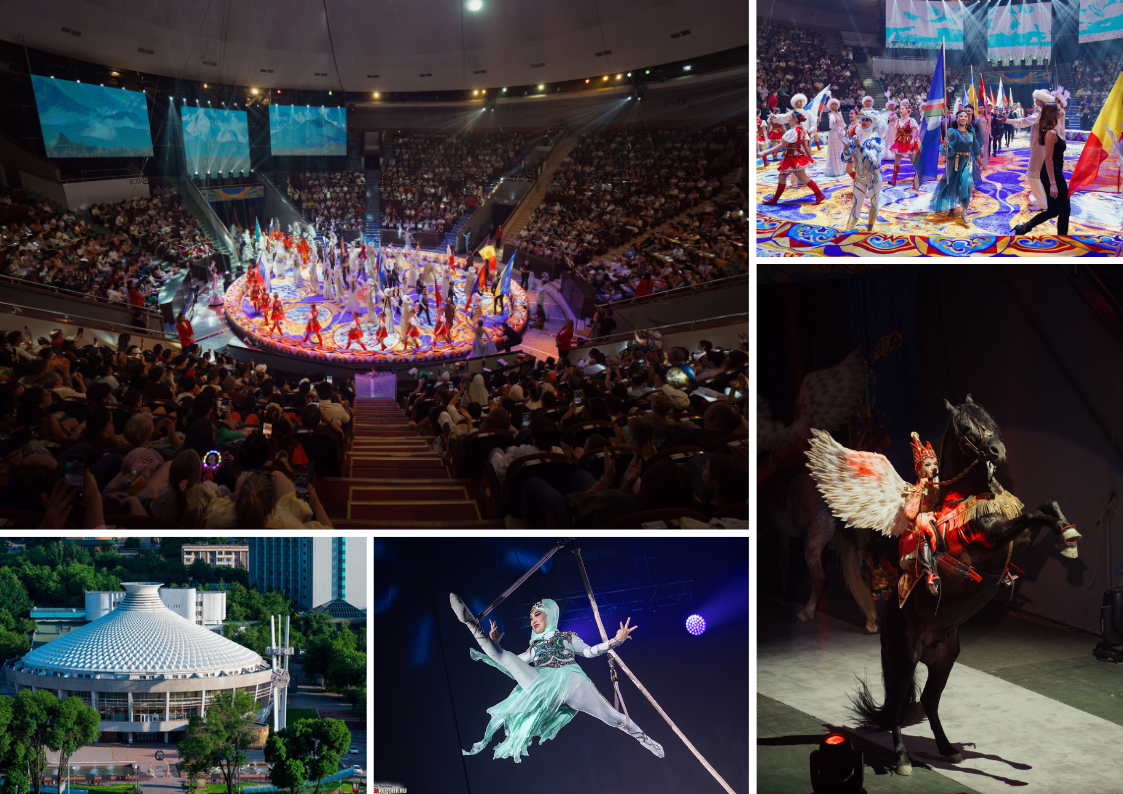
Professor Anjan Ghosh’s research shows how Kazakhstan’s iconic Soviet-era circus rebuilt its organizational identity by reinterpreting, rather than erasing, its past amid the country’s post-Soviet cultural and social transformation.
Geopolitical upheavals, war, deglobalization, and resurgent nationalism are increasingly unsettling organizations and the identities they are built on. When the dominant logic an organization was founded on starts to crumble — and no clear alternative has yet taken its place — how does it answer the most basic question of all: who are we now? We explored this question through six years of ethnography at the Kazakh State Circus (KSC), an iconic Soviet cultural institution that found itself stranded between two worlds in post-Soviet Kazakhstan.
In our article, “Epigenetic Alteration: Identity Transformation of an Iconic Soviet Circus in Post-Soviet Kazakhstan” (Organization Studies), we trace how the circus rebuilt its identity — not by demolishing its Soviet past, but by quietly re-expressing it. Our analysis draws on more than 1,500 days on site, 67 interviews, and an extensive archive of reports, media, and recordings.
An Organization Caught Between Two Worlds
The KSC was inaugurated in 1968 at the initiative of the first Secretary of the Communist Party of the Kazakh SSR, and moved permanently to Almaty in 1972. It has operated under the administration of the City of Almaty since 2002. After Kazakhstan’s independence in 1991, the Soviet logic the circus was born into began eroding fast, while the neo-nationalist call for a Kazakh identity remained fragmented — caught between neo-liberalism, the return of religion, and the revival of Kazakh culture.
When a new management team took over in 2016, it inherited three pressures at once: a state push to shed the circus’s Soviet identity; bilateral tensions after some ethnic-Russian employees complained of minority oppression; and footfall dropping so sharply that the circus had become dependent on state subsidies. Between 2016 and 2022, the KSC undertook the identity-rebuilding project at the heart of our study.
Ambiguity Is Not the Same as Complexity
Much research on organizational identity assumes that change happens within environments that are complex but still stable — plural logics that nonetheless serve as reliable reference points. We draw a sharper line. Complexity assumes a set of plural but stable templates to draw on; ambiguity means the templates themselves have eroded and the alternatives are fragmented. Under ambiguity, an organization loses any settled answer to “who we are,” and the familiar toolkit — bricolage, selective coupling, narrative reframing — falls short, because each of those approaches assumes a stable identity base that simply was not available to the KSC.
Epigenetic Alteration: Changing the Expression, Not the Core
To capture what we observed, we borrow a metaphor from biology, where gene expression is modified without altering the underlying DNA. Epigenetic alteration is a collective, negotiated, and recursive process through which an organization re-expresses its inherited identity elements — surfacing them, re-coding their meanings, and weaving them into new narratives — reconstructing identity without rupture while keeping the option to reverse course.
“Transformation did not require rejecting the Soviet past or preserving it unchanged.”
— Shaz Ansari, co-author, University of Cambridge
At the KSC, this re-expression unfolded through four mechanisms:
1.Shared sensing of identity threats. Long-tenured members — management, veterans, and artists of Russian ethnicity — surfaced the tensions threatening the circus, both external (the national-identity drive, bilateral issues, and shifting audience tastes) and internal (an aging workforce, decaying infrastructure, and a younger generation that dismissed the place as “an age-old Soviet organization that literally stinks”).
2.Collective rediscovery of sedimented meanings. Rather than swapping out surface features, members dug into the circus’s core. A veteran’s old “Soviet Circus” magazine sparked the idea of a museum; the team mapped the circus into nine main and eight additional genres, and identified the elements most open to alteration — above all the horse. Once a generic part of the act, it was recast from a symbol of imperial control into a carrier of “nomadness” — evoking the steppe, freedom, and national memory, and echoing the tulpar, the winged horse on Kazakhstan’s state emblem.
3.Negotiated weaving of identity carriers and logics. Through negotiated mobilization (drawing on employees’ families and social networks) and collective experimentation (accommodating religious practice and searching for a binding story), the circus became a circus-theatre. A new “action–acting” format — circus skill integrated with storytelling, debuting through a Nutcracker show — gave the emerging identity a workable form.
4.Cautious reinforcing of emergent identity. The new identity was stabilized through facilitated diffusion (a run of Kazakh folktale shows such as “Er Tostik” and SKIFIY; a spin-off stunt company, Nomad Stunts; and an action-acting degree course at the T. Zhurgenov Kazakh National Academy of Arts) and careful dilution — reducing, but never deleting, legacy Soviet elements so as not to alienate the sizable ethnic-Russian audience.
Diluting, Not Deleting, the Past
Crucially, epigenetic alteration is non-destructive. Legacy elements were neither preserved untouched nor erased, but selectively re-expressed, diluted, or re-signified. Classic acts remained on the bill; Father Frost, the Soviet equivalent of Santa, now appears in a dress with heavy Kazakh motifs. Because the circus kept this option open, it could even partner with Russia’s Yuri Nikulin circus on “Magic Circus Tango” in memory of a Soviet-era clown — reversibility in practice, not just in theory.
Why It Matters
By 2023–2025, the circus had regained audience interest and government recognition, meeting the three charters it was given in 2016: to become a cultural symbol of Almaty and Kazakhstan, to turn profitable, and to manage its internal tensions. For research and practice, the study offers three lessons:
1.Look at ambiguity, not just complexity. When dominant logics erode and alternatives are fragmented, identity change cannot be explained by reframing, bricolage, or adaptation alone.
2.Identity can be rebuilt on shifting ground. Organizations can reconstruct identity even while the legacy base is itself rapidly destabilizing — by first surfacing and re-coding inherited carriers before recombining them.
3.Stabilize by spreading and tempering, not by closing down. An emerging identity can be steadied under continued ambiguity through interorganizational diffusion and the careful dilution — rather than deletion — of the legacy.
More Than a Circus: A Milestone for Kazakhstani Scholarship
The paper marks a milestone of another kind. To our knowledge, it is among the very few studies in a major international management journal built around a Kazakhstan organization, grounded in the country’s own socio-cultural context, and co-authored with Kazakh scholars from leading Kazakh universities. Reaching that point took more than six years of fieldwork inside the circus, along with a long sequence of rewrites and revisions before the argument was sharp enough to publish.
The point has resonated beyond our team. Dr. Sanat Kozhakhmet, a Kazakhstani scholar and Senior Lecturer at Oxford Brookes Business School, read the study as an example of how a local story — asked the right theoretical question — can become part of global scholarship: a reminder that Kazakhstan is not merely an “interesting case” but a source of ideas that can travel to a world audience.
“The most powerful ideas are found nearby — in our organizations and cultural institutions.”
— Dr. Sanat Kozhakhmet, Oxford Brookes Business School
That is the wider encouragement, especially for researchers across Central Asia. Epigenetic alteration alters without destroying the past, and it works best where legacy carriers, memories, and practices still survive to be excavated, and where there is enough organizational continuity to negotiate them — conditions common to transitional economies and contested geopolitical settings. For any organization navigating its own ambiguous moment, the circus offers a counter-intuitive lesson: sometimes the surest way forward is to change what your inheritance means, rather than to discard it.
Read the complete article in Organization Studies.
In our article, “Epigenetic Alteration: Identity Transformation of an Iconic Soviet Circus in Post-Soviet Kazakhstan” (Organization Studies), we trace how the circus rebuilt its identity — not by demolishing its Soviet past, but by quietly re-expressing it. Our analysis draws on more than 1,500 days on site, 67 interviews, and an extensive archive of reports, media, and recordings.
An Organization Caught Between Two Worlds
The KSC was inaugurated in 1968 at the initiative of the first Secretary of the Communist Party of the Kazakh SSR, and moved permanently to Almaty in 1972. It has operated under the administration of the City of Almaty since 2002. After Kazakhstan’s independence in 1991, the Soviet logic the circus was born into began eroding fast, while the neo-nationalist call for a Kazakh identity remained fragmented — caught between neo-liberalism, the return of religion, and the revival of Kazakh culture.
When a new management team took over in 2016, it inherited three pressures at once: a state push to shed the circus’s Soviet identity; bilateral tensions after some ethnic-Russian employees complained of minority oppression; and footfall dropping so sharply that the circus had become dependent on state subsidies. Between 2016 and 2022, the KSC undertook the identity-rebuilding project at the heart of our study.
Ambiguity Is Not the Same as Complexity
Much research on organizational identity assumes that change happens within environments that are complex but still stable — plural logics that nonetheless serve as reliable reference points. We draw a sharper line. Complexity assumes a set of plural but stable templates to draw on; ambiguity means the templates themselves have eroded and the alternatives are fragmented. Under ambiguity, an organization loses any settled answer to “who we are,” and the familiar toolkit — bricolage, selective coupling, narrative reframing — falls short, because each of those approaches assumes a stable identity base that simply was not available to the KSC.
Epigenetic Alteration: Changing the Expression, Not the Core
To capture what we observed, we borrow a metaphor from biology, where gene expression is modified without altering the underlying DNA. Epigenetic alteration is a collective, negotiated, and recursive process through which an organization re-expresses its inherited identity elements — surfacing them, re-coding their meanings, and weaving them into new narratives — reconstructing identity without rupture while keeping the option to reverse course.
“Transformation did not require rejecting the Soviet past or preserving it unchanged.”
— Shaz Ansari, co-author, University of Cambridge
At the KSC, this re-expression unfolded through four mechanisms:
1.Shared sensing of identity threats. Long-tenured members — management, veterans, and artists of Russian ethnicity — surfaced the tensions threatening the circus, both external (the national-identity drive, bilateral issues, and shifting audience tastes) and internal (an aging workforce, decaying infrastructure, and a younger generation that dismissed the place as “an age-old Soviet organization that literally stinks”).
2.Collective rediscovery of sedimented meanings. Rather than swapping out surface features, members dug into the circus’s core. A veteran’s old “Soviet Circus” magazine sparked the idea of a museum; the team mapped the circus into nine main and eight additional genres, and identified the elements most open to alteration — above all the horse. Once a generic part of the act, it was recast from a symbol of imperial control into a carrier of “nomadness” — evoking the steppe, freedom, and national memory, and echoing the tulpar, the winged horse on Kazakhstan’s state emblem.
3.Negotiated weaving of identity carriers and logics. Through negotiated mobilization (drawing on employees’ families and social networks) and collective experimentation (accommodating religious practice and searching for a binding story), the circus became a circus-theatre. A new “action–acting” format — circus skill integrated with storytelling, debuting through a Nutcracker show — gave the emerging identity a workable form.
4.Cautious reinforcing of emergent identity. The new identity was stabilized through facilitated diffusion (a run of Kazakh folktale shows such as “Er Tostik” and SKIFIY; a spin-off stunt company, Nomad Stunts; and an action-acting degree course at the T. Zhurgenov Kazakh National Academy of Arts) and careful dilution — reducing, but never deleting, legacy Soviet elements so as not to alienate the sizable ethnic-Russian audience.
Diluting, Not Deleting, the Past
Crucially, epigenetic alteration is non-destructive. Legacy elements were neither preserved untouched nor erased, but selectively re-expressed, diluted, or re-signified. Classic acts remained on the bill; Father Frost, the Soviet equivalent of Santa, now appears in a dress with heavy Kazakh motifs. Because the circus kept this option open, it could even partner with Russia’s Yuri Nikulin circus on “Magic Circus Tango” in memory of a Soviet-era clown — reversibility in practice, not just in theory.
Why It Matters
By 2023–2025, the circus had regained audience interest and government recognition, meeting the three charters it was given in 2016: to become a cultural symbol of Almaty and Kazakhstan, to turn profitable, and to manage its internal tensions. For research and practice, the study offers three lessons:
1.Look at ambiguity, not just complexity. When dominant logics erode and alternatives are fragmented, identity change cannot be explained by reframing, bricolage, or adaptation alone.
2.Identity can be rebuilt on shifting ground. Organizations can reconstruct identity even while the legacy base is itself rapidly destabilizing — by first surfacing and re-coding inherited carriers before recombining them.
3.Stabilize by spreading and tempering, not by closing down. An emerging identity can be steadied under continued ambiguity through interorganizational diffusion and the careful dilution — rather than deletion — of the legacy.
More Than a Circus: A Milestone for Kazakhstani Scholarship
The paper marks a milestone of another kind. To our knowledge, it is among the very few studies in a major international management journal built around a Kazakhstan organization, grounded in the country’s own socio-cultural context, and co-authored with Kazakh scholars from leading Kazakh universities. Reaching that point took more than six years of fieldwork inside the circus, along with a long sequence of rewrites and revisions before the argument was sharp enough to publish.
The point has resonated beyond our team. Dr. Sanat Kozhakhmet, a Kazakhstani scholar and Senior Lecturer at Oxford Brookes Business School, read the study as an example of how a local story — asked the right theoretical question — can become part of global scholarship: a reminder that Kazakhstan is not merely an “interesting case” but a source of ideas that can travel to a world audience.
“The most powerful ideas are found nearby — in our organizations and cultural institutions.”
— Dr. Sanat Kozhakhmet, Oxford Brookes Business School
That is the wider encouragement, especially for researchers across Central Asia. Epigenetic alteration alters without destroying the past, and it works best where legacy carriers, memories, and practices still survive to be excavated, and where there is enough organizational continuity to negotiate them — conditions common to transitional economies and contested geopolitical settings. For any organization navigating its own ambiguous moment, the circus offers a counter-intuitive lesson: sometimes the surest way forward is to change what your inheritance means, rather than to discard it.
Read the complete article in Organization Studies.
Ghosh, Anjan, Sneh Shakti, Shaz Ansari, Nurlykhan Aljanova, and Nurbakyt Bokebayev. "Epigenetic Alteration: Identity transformation of an iconic Soviet circus in post-Soviet Kazakhstan." Organization Studies (2026): 01708406261459057. https://doi.org/10.1177/01708406261459057
This story may not be republished without permission from Nazarbayev University Graduate School of Business. For additional information, please contact NUGSB Insights at gsbresearch@nu.edu.kz
